
The Khewra Salt Mine sits in the Salt Range of northern Punjab, Pakistan, and it is where much of the world’s “Himalayan” pink salt story begins. It is a working mine, a tourist site that draws over 300,000 visitors a year, and a source of rock salt sold far beyond Pakistan. This guide covers its history, how the salt formed, what you will see underground and how to visit. It also explains something most guides skip: how salt from Khewra and the wider Salt Range is processed, graded and shipped to businesses around the world.
Khewra Salt Mine at a glance
| Fact | Detail |
|---|---|
| Location | Khewra, north of Pind Dadan Khan, Jhelum District, Punjab, Pakistan |
| Distance | About 200 km from both Islamabad and Lahore |
| Nearest motorway exit | Lilla interchange on the M2, about 30 km away |
| Elevation | About 945 ft above sea level |
| Depth into the mountain | About 2,400 ft from the entrance |
| Underground area | About 110 km² |
| Operator | Pakistan Mineral Development Corporation (PMDC) |
| Tourist tunnel | Main ground-level tunnel, developed by Dr Warth in 1872 |
| Largest chamber | Assembly Hall, more than 250 ft high |
| Visitors | Over 300,000 a year (PMDC) |
| Opening hours | 9:00 AM to 6:00 PM, every day |
| Foreign adult ticket | US$24 (incl. tax) |
Sources: PMDC tourist information and Jhelum District Government. Prices and hours may change; check PMDC before you travel.
A short history of the Khewra Salt Mine
Salt has been dug from these hills for centuries, but reliable records only begin much later than the stories. It helps to separate the two.
The Alexander the Great legend
The most repeated story says that around 320 BC, horses belonging to Alexander the Great’s army stopped to rest in the area and began licking the rocks. Soldiers noticed, tasted the stone and found salt. It is a good story and you will hear it on the tour, but it is a local legend rather than documented history. No contemporary account records it.
The Mughal and Sikh periods
By the Mughal era, salt from the Salt Range was being traded in markets as far away as Central Asia. As Mughal power declined, the mines passed into Sikh hands in the early 19th century.
British rule and the 1872 tunnel
The British took control of the mines after annexing the Punjab in 1849. In 1870 the mine was renamed the Mayo Salt Mine, after Lord Mayo, the Viceroy of India, and that name is still used alongside Khewra. In 1872, the mining engineer Dr Warth developed the main ground-level tunnel. That tunnel is still the route visitors walk and ride today.
The period also has a darker side. Several accounts say that in 1876, during a strike, 12 miners were shot at the mine entrance. The story is widely repeated, though contemporary records of it are hard to find.
After independence
After 1947, the mine passed through several state bodies, including the Pakistan Industrial Development Corporation, before the Pakistan Mineral Development Corporation (PMDC) took it over in 1974. In February 2002, PMDC launched a project to develop the site for tourism, and the resort was inaugurated on 3 April 2003. In 2013, the old workshop became a Geological & Mining Museum.
How the salt formed, and why it is pink
The salt at Khewra is far older than the Himalayas themselves. It belongs to the Salt Range Formation, which geologists date to the late Ediacaran and early Cambrian periods, roughly 540 to 600 million years ago. It formed as a shallow, enclosed sea repeatedly flooded and evaporated, leaving layers of salt behind. Over time those layers were buried, compressed and later pushed upwards by the same tectonic forces that raised the mountains to the north.
The name “Himalayan salt” is therefore a trade name rather than a precise address. The salt comes from the Salt Range, a line of hills in Punjab some distance south of the Himalayas proper.
Most of the rock is halite (sodium chloride). The pink, orange and deep red tones come from small traces of other minerals, chiefly iron oxide. Colour varies from seam to seam. Some bands are almost clear or white, others light pink, and some a rich reddish brown. That variation is why the chambers look so striking under lights, and why exporters sort the salt by colour before it is sold.
Khewra is not the only pink salt mine in the region. PMDC also runs salt mines at Warcha and Kalabagh, further west along the Salt Range, and other operators hold rock salt leases nearby. Much of the pink salt on the market comes from these mines as well.
How salt is mined: the room-and-pillar method
Khewra is worked using the room-and-pillar method. Miners cut out chambers (the “rooms”) and leave large columns of untouched salt standing between them (the “pillars”). Those pillars carry the weight of the rock above, so the mine does not rely on artificial supports. Engineers test the pillars to keep the workings stable; a 2023 study measured pillar stability at Khewra, Warcha and Kalabagh.
The method explains the mine’s shape. Tunnels run level into the mountain from the entrance, with chambers opening off them on several levels. Some of the older chambers, left empty after extraction, are the spaces now used for the tourist attractions.
What you will see inside the pink salt mine
The tourist route follows Dr Warth’s 1872 tunnel into the mountain. Walls, ceilings and floors are all salt, and the lighting brings out every shade from white to deep red. PMDC lists these as the main attractions:
- The salt mosque. A small mosque built from salt bricks, lit from within. It is one of the most photographed spots in the mine.
- Shish Mahal. A chamber of transparent, light-pink salt. The name means “palace of mirrors”, and the way the light passes through the walls explains why.
- The Assembly Hall. The largest open space on the route, more than 250 ft high.
- Salt bridges over brine ponds. Walkways cross pools of saturated salt water collected in old workings. The still surface reflects the chambers above.
- Illuminated chambers. Several galleries are lit in colour, with salt sculptures and replicas of well-known landmarks.
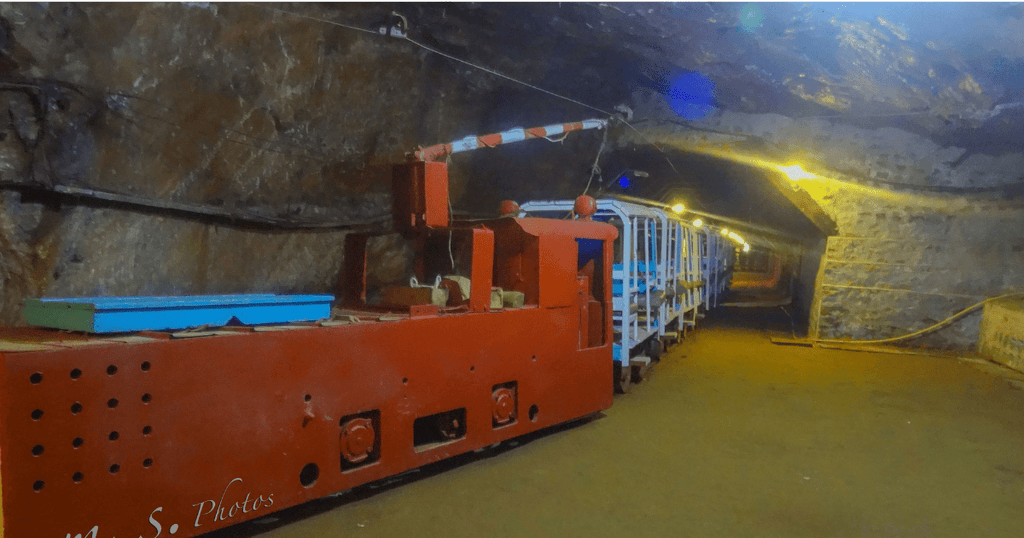
- The electric train. A small train runs along the main tunnel, useful if you want to save your legs for the chambers.
- The Geological & Mining Museum. Housed in the old workshop since 2013, it explains how the mine has been worked.
- The souvenir shop. Carved salt items, cooking blocks and lamps are on sale.
PMDC also runs an asthma resort inside the mine, with 10 beds and 50 seats. It is a facility within the site; this guide makes no claims about its effects.
If the souvenir shop catches your eye, the same carved pieces are made in volume for shops abroad. Our Himalayan salt lamps are cut from Salt Range rock in natural and shaped forms.
Visiting the Khewra Salt Mine: timings, tickets and getting there
The prices and timings below are as published by PMDC, the mine’s operator. They may change, so check the PMDC tourist page before you set off.
Opening hours
The mine is open from 9:00 AM to 6:00 PM every day, including Sundays and public holidays.
Ticket prices
| Visitor | Entry fee (incl. tax) |
|---|---|
| Foreign adult | US$24 |
| Foreign student | US$12 |
| Pakistani adult | Rs. 475 |
| Pakistani student | Rs. 265 |
| Senior citizen (60+) | Rs. 265 |
| Child (2–12) | Rs. 265 |
| Infant (under 2) | Free |
| Train ride inside the mine (extra) | Rs. 285 |
How to reach Khewra
Khewra lies north of Pind Dadan Khan in Jhelum District, about 200 km from both Islamabad and Lahore. By road, take the M2 motorway and leave at the Lilla interchange; the mine is about 30 km from there. Most visitors come by car or on an organised day trip from either city, which is the simplest option for overseas travellers.
What to expect on the day
Inside, the temperature stays at around 18°C (64°F) all year, so it feels cool in summer and mild in winter. Floors can be uneven and damp near the brine ponds, so wear shoes with good grip. Allow a few hours to see the main chambers, the museum and the shop without rushing.
From the Salt Range to the world: how pink salt is processed and exported
Most visitors leave Khewra knowing how the salt got into the mountain. Few learn how it ends up in a grinder in Manchester or a spa in Texas. PMDC sells Khewra pink rock salt commercially, and salt from other Salt Range mines follows a similar path. Here is how that path usually runs.
Extraction and sorting
Salt leaves the mine as large blocks and broken rock. At the surface it is sorted by hand, mainly by colour and clarity: white, light pink, dark pink and red. Pieces with clay bands, grey streaks or other visible impurities are set aside at this stage.
At Mount Grain, we source raw salt from established mines in the Salt Range, including the Khewra area. Before a lot is accepted, we check it for colour consistency, clarity and visible impurities, and set aside rock with heavy clay bands or grey streaks.
Crushing, grading and quality checks
Sorted rock is crushed and screened into grain sizes. Buyers usually choose from fine (for table salt and seasoning), coarse (for grinders), and larger chunks and lumps. Uncrushed pieces go to cutting workshops for cooking slabs, carved items and lamps. You can see the grades we supply on our Himalayan pink salt page, and larger pieces on our Himalayan rock salt page.
Food-grade salt is handled in cleaner conditions than salt meant for animal licks or decorative use. Importers who need a lab analysis for their own market often arrange independent testing on a pre-shipment sample, through an inspection company of their choice.
Our salt is sorted by colour by hand, then crushed and machine-screened into consistent grain sizes. Each lot is inspected again before packing.Mount Grain is registered with the US FDA, and our edible salt range is Halal and Kosher certified.
Packing and export
Graded salt is packed to the buyer’s specification. Formats range from retail jars and pouches to 25 kg (55 lbs) sacks and bulk bags of around 1,000 kg (2,205 lbs), both common in the trade. Private-label packing is also popular with importers who sell under their own brand.
Export shipments normally travel by sea container from Karachi or Port Qasim. Paperwork usually includes a commercial invoice, packing list and certificate of origin. Natural rock salt is generally classified under HS heading 2501; confirm the exact code with your customs broker.
We ship to more than 20 countries, including the UK, US, Canada, Germany and the UAE. Minimum order and lead time depend on the product and packaging, and are confirmed with your quote. We quote on FOB or CIF terms with full export documentation.
If you are comparing suppliers, our Himalayan salt wholesale page sets out how we work with importers, distributors and food manufacturers.
How to tell genuine Himalayan salt from fakes
Because pink salt sells at a premium, some products on the market are ordinary salt with added colouring, or salt of unclear origin sold under the Himalayan name. In February 2025, for example, Azerbaijan’s Food Safety Agency reported counterfeit Himalayan pink salt that had come from Iran. A few checks help.
- Look at the colour range. Genuine Salt Range salt is uneven. A bag will hold crystals from near-white to deeper pink. Perfectly uniform colour is a warning sign.
- Check the origin. Khewra Pink Rock Salt is a registered Geographical Indication, with PMDC as the registrant body. Genuine Salt Range salt should state Pakistan as its country of origin.
- Check the lamps. Real salt lamps are heavy for their size, feel slightly rough and show natural variation in colour. Very bright, uniform or glassy-looking pieces deserve a closer look.
- Ask for documents. A reputable supplier can provide a certificate of origin from Pakistan with every shipment.
- Be wary of prices far below the market. Processing, grading and freight all cost money.
For business buyers, documents matter most. A visual check cannot confirm origin or purity; a certificate of origin and, where your market requires it, independent lab testing can.
Every Mount Grain shipment comes with a commercial invoice, packing list and certificate of origin.
Sourcing Himalayan salt for your business
Mount Grain supplies pink salt, rock salt, salt lamps and shilajit from the Salt Range to buyers worldwide, with offices in Lahore and London. If you are planning an order or comparing suppliers, tell us the grades, pack sizes and volumes you need and we will send a quote. Contact Us.
Frequently asked questions
Where is the Khewra Salt Mine?
The Khewra Salt Mine is in Khewra, north of Pind Dadan Khan in Jhelum District, Punjab, Pakistan. It is about 200 km from both Islamabad and Lahore. By road, leave the M2 motorway at the Lilla interchange; the mine is roughly 30 km from there.
What are the Khewra Salt Mine timings and ticket prices?
PMDC lists opening hours of 9:00 AM to 6:00 PM daily, including Sundays and public holidays. Foreign adults pay US$24 and foreign students US$12; Pakistani adults pay Rs. 475. The train ride costs Rs. 285 extra. Prices can change, so check PMDC’s tourist page before visiting.
Did Alexander the Great discover the salt?
That is a local legend. The story says Alexander’s horses licked the rocks around 320 BC, revealing the salt. It is told on tours, but no contemporary record confirms it. The documented history of the mine is far more recent, including Dr Warth’s tunnel of 1872.
How old is the salt at Khewra?
The salt belongs to the Salt Range Formation, which geologists date to the late Ediacaran and early Cambrian periods, roughly 540 to 600 million years ago. It formed as an ancient sea evaporated again and again, leaving layers of salt that were later buried and pushed upwards. It is far older than the Himalayas.
Why is Himalayan salt pink?
Most of the rock is sodium chloride. The pink to red shades come from traces of other minerals, mainly iron oxide. The amount varies from seam to seam, so the salt ranges from near-white to deep red, and exporters sort it by colour before grading it.
Is Khewra the only source of Himalayan pink salt?
No. Khewra is the best-known pink salt mine, but PMDC also runs salt mines at Warcha and Kalabagh along the same Salt Range, and other operators hold leases nearby. Salt sold as “Himalayan” may come from any of them. If origin matters to you, ask your supplier which mine the salt comes from.
Can businesses buy Khewra pink salt in bulk?
Yes. PMDC sells Khewra rock salt commercially, and exporters supply Salt Range salt in bulk to importers, distributors and food manufacturers. Buyers usually specify grade, grain size, pack format and volume, then receive a quote covering shipping terms and export documents.
What documents should come with a pink salt export order?
Expect a commercial invoice, packing list and certificate of origin. If your market requires a lab analysis, many importers arrange independent testing on a pre-shipment sample. Your customs broker will confirm the tariff code, usually under HS heading 2501, and any import rules for your country.