
Rock salt is salt that has been mined from underground rather than evaporated from the sea. Geologists call it halite, and it is made almost entirely of sodium chloride, the same compound that sits in your salt shaker.
That is the short answer. The longer one depends on where you are standing when you ask. Search “rock salt” in Manchester in January and you will mostly find bags of brown grit for icy driveways. Ask the same question in Lahore and you will be pointed towards sendha namak, the pink salt that fills jars in every kirana store. Both are rock salt. Only one belongs on your food.
This guide walks through what rock salt actually is, how it formed, where it comes from in Pakistan and the UK, and what the evidence says about its health reputation. We work with rock salt from the Salt Range every day, so we will also share the practical details that rarely make it into encyclopaedia entries.
Rock salt, in one plain answer
Rock salt is the natural, mineral form of sodium chloride (NaCl), dug or cut from ancient underground deposits. It forms large crystals, often cubic, and it is usually sold crushed into chunks, granules or fine powder.
Chemically, it is not a different substance from table salt. The difference lies in processing. Table salt is refined, ground very fine and often mixed with anti-caking agents and iodine. Rock salt is typically just crushed, washed or screened, so it keeps whatever trace minerals and impurities came out of the ground with it.
One name, two very different salts
Here is where most confusion starts. “Rock salt” covers two products that should never be swapped.
| Food-grade rock salt | De-icing rock salt (grit) | |
|---|---|---|
| Typical colour | White, pink, light red | Brown or grey |
| What’s left in | Small amounts of natural minerals | Sand, clay and insoluble rock |
| Sodium chloride | Usually high, sorted for purity | Often around 90–95% |
| Made for | Cooking, preserving, table use | Roads, paths, car parks |
| Safe to eat? | Yes, in normal amounts | No |
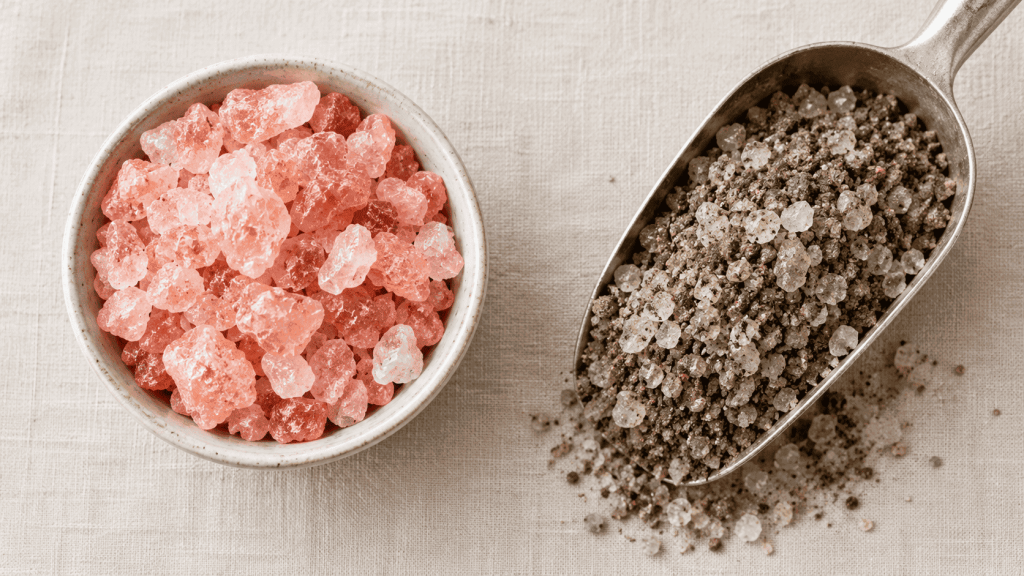
Manufacturer Cargill notes that most of the impurity in raw rock salt is insoluble material, largely gypsum, and that de-icing salt only needs to reach about 95% sodium chloride. That is fine for melting ice. It is not fine on chips.
In the UK, the grit in council bins comes from a mine near Winsford in Cheshire. Milton Keynes Council explains that it uses brown rock salt because it is drier than white salt and spreads more easily. The brown colour is simply the mud and marl that come up with it.
So if a recipe calls for rock salt, it means food-grade crystals. If your ice-cream maker calls for rock salt, it only needs cheap coarse salt to chill the ice, since none of it touches the mix. And if a pet has been walking on gritted pavements, wipe its paws: salt and grit irritate skin and are not meant to be licked off.
How rock salt forms
Every rock salt deposit began as water. Picture a shallow sea or salty lake in a hot, dry climate, cut off from the open ocean. The sun evaporates it faster than fresh water can refill it. Minerals drop out in a predictable order, and once the brine is concentrated enough, sodium chloride crystallises in thick layers on the floor.
Repeat that over thousands of years, bury it under mud and rock, and you get evaporite beds that can be hundreds of metres thick. Because salt is light and slightly plastic under pressure, these layers often bend, fold and push upwards into domes. That is why salt deposits are rarely flat, and why mines follow seams that twist through the hills.
The salt in Pakistan’s Salt Range is old by any measure. The Khewra mine is cut into the base of the Salt Range Formation, a sequence of folded and faulted evaporites dated to the Ediacaran–early Cambrian, roughly 540 to 600 million years ago. The UK’s Cheshire salt is much younger, laid down when hot conditions evaporated inland seas in the Triassic period.
Where rock salt comes from: Khewra and Winsford
Khewra, Punjab, Pakistan
The Khewra Salt Mine sits in Jhelum District, on the edge of the Pothohar Plateau where the Salt Range rises from the Indus plain. It is usually described as the second-largest salt mine in the world and is the main source of what the world now calls Himalayan pink salt.
Local history holds that the deposit became widely known around 326 BC, when the horses of Alexander the Great’s army were seen licking the rocks. Systematic mining began under British rule, when mining engineer Dr H. Warth laid out the main tunnel at ground level in 1872 using the room-and-pillar method still visible today. In places the halite is around 99% pure, with bands of white, pink and deep red running through the walls.
Annual output figures vary by source and year, from roughly 315,000 to 400,000 tonnes. Treat any single number you read online as a snapshot, not a fixed fact. Khewra is also a major tourist site, with a salt-brick mosque inside the mine.
Winsford, Cheshire, UK
The UK’s best-known rock salt mine is at Winsford, run by Compass Minerals UK. It opened in 1844 and lies around 200 metres beneath the Cheshire countryside. According to Lincolnshire County Council, the mine has more than 150 miles of underground roads, and salt is crushed to around 6 mm granules for gritting. Its output goes overwhelmingly to winter road maintenance, not kitchens.
This is the source of the UK’s “rock salt equals grit” habit. Most of the edible rock salt on British supermarket shelves, especially pink salt, is imported, much of it from the Salt Range in Pakistan.
Why rock salt isn’t always white
Pure halite is colourless. The colours come from what is trapped inside or around the crystals.
- Pink to red: traces of iron oxide. This is the signature of Khewra salt.
- White or clear: very pure sections of the seam.
- Grey: clay or other mineral inclusions.
- Brown: marl and mud, typical of de-icing grit.
Darker colour does not mean better salt. In food salt, colour is mostly about appearance and how a seam was sorted. In grit, it is a sign the salt was left unrefined because the job does not need it to be clean.
One related product often causes confusion: kala namak, or black salt. It starts as rock salt, but it is heated with other ingredients, which gives it its sulphurous smell and pinkish-grey colour. It is a processed product rather than salt as mined.
Rock salt vs table salt vs sea salt
All three are mostly sodium chloride. What changes is source, processing and texture.
| Rock salt | Table salt | Sea salt | |
|---|---|---|---|
| Source | Mined underground deposits | Rock salt or brine, then refined | Evaporated seawater |
| Processing | Crushed, sorted, sometimes washed | Refined, ground fine, additives | Varies; flakes or crystals |
| Additives | Usually none | Anti-caking agents; iodine in some brands | Usually none |
| Texture | Coarse to fine | Very fine, uniform | Flaky or coarse |
| Iodine | None unless added | Sometimes | Negligible |
Taste differences are smaller than marketing suggests. Coarse rock salt can seem “less salty” by the spoonful simply because big crystals leave air gaps. Gram for gram, the saltiness is close.
Is rock salt healthier? What the evidence actually says
This is the question most articles get wrong, so it deserves a straight answer: rock salt is not meaningfully healthier than other salt.
Yes, unrefined rock salt contains trace minerals such as magnesium, calcium, potassium and iron. But the amounts are tiny. In 2020, Nutrition Research Australia tested 31 pink salt samples sold in Australia. The researchers concluded you would need to eat more than 30 g a day, about six teaspoons, for those minerals to make a real difference to your diet. That much salt would do far more harm than good.
The same study found that samples with more minerals also tended to carry more non-nutritive elements, including some heavy metals. Only one sample, from Peru, exceeded the national limit for lead. Pink salts from the Himalayan region were within limits but sat at the higher end for mineral content overall. The practical lesson is simple: buy from a supplier who can tell you where the salt came from and how it was handled.
Sodium is sodium. The NHS advises adults to eat no more than 6 g of salt a day, and that ceiling applies to pink salt, sea salt and table salt equally. Choose rock salt for its texture, flavour or because you like knowing exactly where your food comes from. Do not choose it as a health supplement.
The iodine question in Pakistan and the UK
Rock salt contains no meaningful iodine unless it is iodised after mining. Iodine supports thyroid function and is especially important during pregnancy and childhood.
In Pakistan, the government adopted universal salt iodisation in 1994, and the 2018 National Nutrition Survey found 79.6% of households using iodised salt, up from 17% in 2003. If your family uses only plain sendha namak, it is worth making sure iodine comes from elsewhere, or keeping iodised salt in the kitchen too.
In the UK, the picture is different. There is no salt iodisation policy, and most iodine comes from milk and dairy. A 2024 review found iodised table salt in only three of ten major supermarket chains. If you have cut back on dairy and fish, switching to rock salt will not fix an iodine gap. A GP or dietitian can advise.
What rock salt is used for
Rock salt is one of the most versatile raw materials on earth. Its main uses fall into four groups.
- Kitchen: everyday seasoning, grinders, brining, pickling, baking in a salt crust, and cooking or serving on salt slabs. In Pakistan and across South Asia, sendha namak is a staple for fasting dishes and chaats.
- Home and wellness: bath soaks, salt lamps and decorative pieces. Treat wellness claims around lamps as about atmosphere and light rather than proven health effects.
- Agriculture: salt licks for cattle, sheep and horses.
- Industry and infrastructure: road de-icing, water softener regeneration and raw material for the chemical industry, including chlorine and caustic soda production.
Cooking with rock salt without ruining the dish
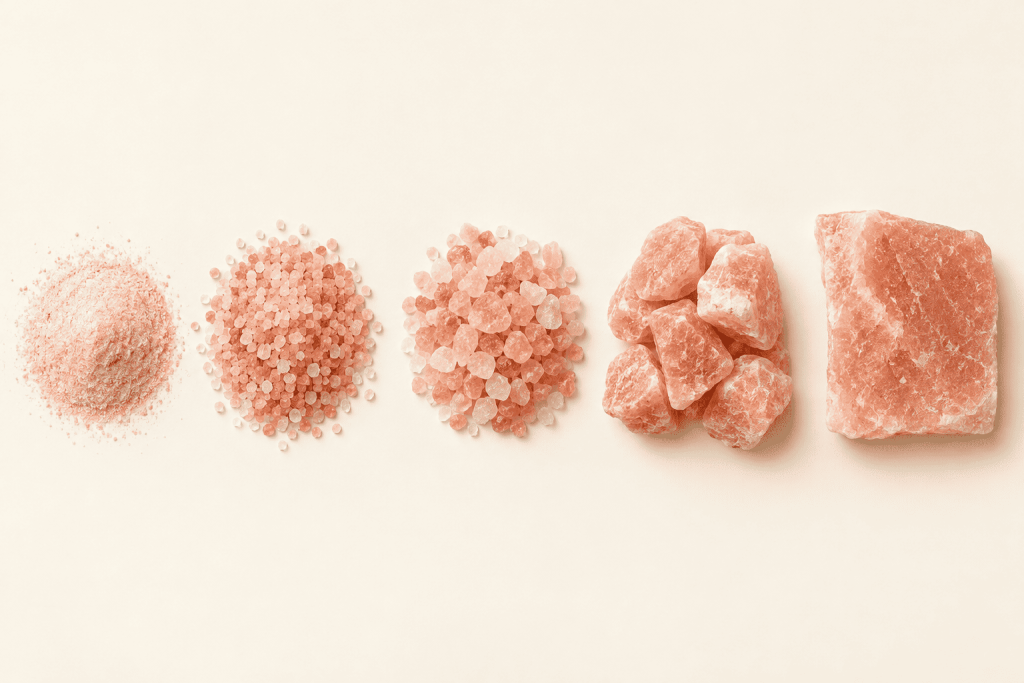
A few habits make rock salt easy to use.
Swap by weight, not by spoon. A teaspoon of fine table salt holds noticeably more salt than a teaspoon of coarse crystals. If a recipe was written for table salt and you are using coarse rock salt, weigh it or start with less and taste.
Match grain to job. Fine grains dissolve fast in sauces and doughs. Medium crystals suit grinders. Coarse crystals work for brines, roasting beds and crusts. Large chunks and slabs are for cooking surfaces and presentation.
Dissolve it for even seasoning. For marinades or raita, dissolve coarse rock salt in a little water first so you do not bite into a crystal.
Store it dry. Unrefined salt has no anti-caking agent, so it clumps in humid kitchens, especially through Pakistan’s monsoon or a damp British winter. An airtight jar fixes most of it. A few grains of uncooked rice in a shaker helps too.
Do not judge by colour alone. A deep pink jar is not automatically better than a pale one. Look at cleanliness and how evenly the crystals have been sorted.
How to judge rock salt quality
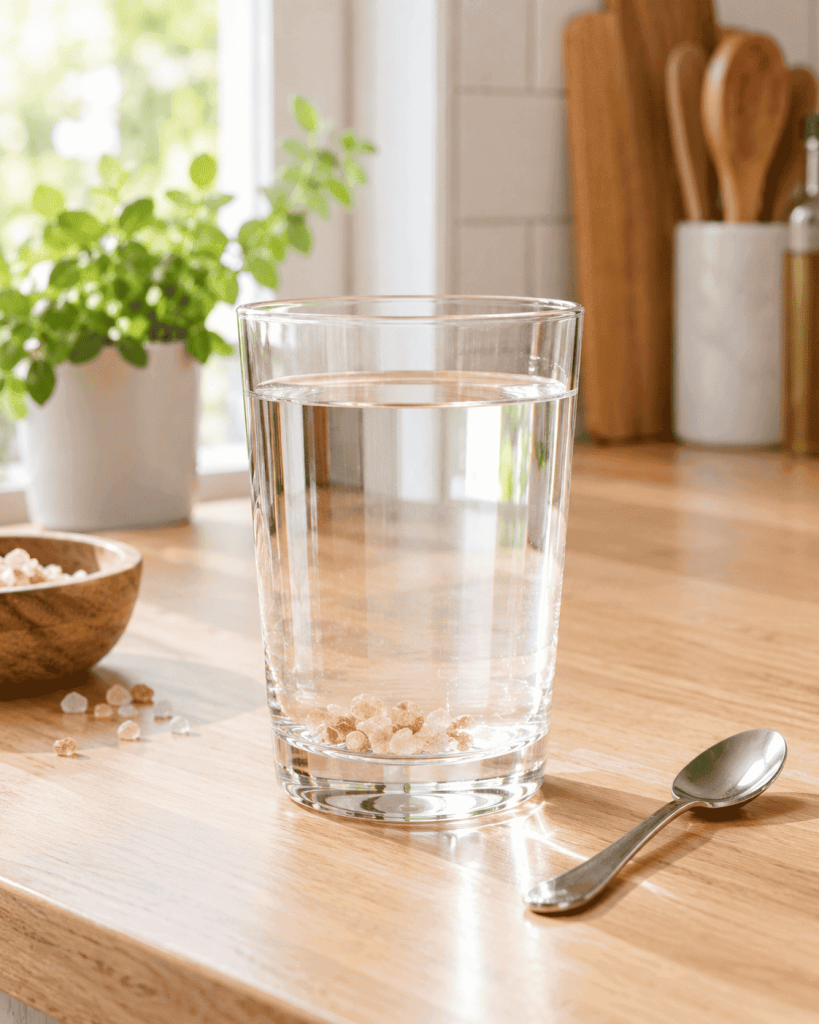
Whether you are buying a 500 g jar or a container load, the same checks apply.
- Dissolve a spoonful in clear water. Good food-grade salt leaves very little sediment. A muddy layer at the bottom means poor sorting or washing.
- Look for foreign matter. Grit, dark specks and dust point to careless crushing or storage.
- Check the smell. Plain rock salt should smell of almost nothing. Earthy or chemical smells are a warning sign.
- Ask about origin. “Himalayan” is a marketing word. Salt from the Salt Range in Punjab is the real source; a reputable seller will say so plainly.
- Check the packaging. Food salt should be sealed and labelled. Torn sacks invite moisture and contamination.
In Pakistani bazaars, a common shortcut is to judge salt by how pink it looks. Colour can be selected, so the water test tells you far more.
Buying rock salt in bulk
If you are a retailer, food manufacturer or importer, the questions change: consistent grain size, reliable sorting, food-safe packing and an exporter who handles the paperwork.
At Mount Grain, we source rock salt from the Khewra region of the Salt Range and supply it in grades from fine grains to raw bulk chunks, shipping to buyers in 20+ countries. Grain size, packing and quantities are confirmed with each quote, so you only pay for what your product actually needs.
Explore our Himalayan rock salt grades or request a wholesale quote.
The short version
Rock salt is halite: mined, mostly sodium chloride, and shaped by seas that dried up millions of years ago. In Pakistan it usually means the pink sendha namak from Khewra. In the UK it usually means grit from Cheshire. Food-grade rock salt is a good, honest ingredient with great texture. It is not a health cure, it has no iodine of its own, and it still counts towards your daily salt limit. Buy it from someone who can tell you where it came from.
FAQs
Is rock salt the same as Himalayan pink salt?
Himalayan pink salt is one type of rock salt. It is mined from the Salt Range in Punjab, Pakistan, mainly around Khewra, and its pink colour comes from traces of iron oxide. Rock salt is the wider term for any salt mined from underground deposits.
Can you eat rock salt?
You can eat food-grade rock salt, such as sendha namak or pink salt sold for cooking. Do not eat de-icing rock salt or grit. It contains sand, clay and other impurities and is not handled to food standards.
What is rock salt called in Urdu?
In Urdu, rock salt is usually called sendha namak or lahori namak. Both names refer to the pink or white salt mined in Pakistan’s Salt Range.
Does rock salt have iodine?
No. Natural rock salt contains no meaningful iodine unless it is iodised after mining. If plain rock salt is your only salt, make sure iodine comes from other sources such as dairy, fish or iodised salt.
Is rock salt healthier than table salt?
Not in any meaningful way. It contains trace minerals, but research from Australia in 2020 found you would need over 30 g a day for them to matter. Both salts are mostly sodium chloride and count towards the same daily limit.
Why is UK rock salt brown?
The brown colour in UK grit comes from marl and clay mined alongside the salt in Cheshire. It is left in because road salt does not need refining, and councils find the drier brown salt spreads more easily.
What is rock salt used for?
Rock salt is used for cooking and seasoning, brining, salt slabs and lamps, animal licks, water softeners, road de-icing and as a raw material for the chemical industry.
How is rock salt formed?
Rock salt forms when ancient seas or salt lakes evaporate, leaving thick layers of crystallised sodium chloride. Over millions of years these layers are buried, compressed and sometimes pushed upwards, creating deposits that are later mined.
Is kala namak (black salt) rock salt?
Kala namak starts as rock salt but is heated with other ingredients, which gives it a sulphurous smell and a dark pinkish-grey colour. It is a processed product rather than salt in its mined form.
Why does my pink salt clump or feel wet?
Unrefined rock salt has no anti-caking agents, so it draws in moisture in humid weather. Store it in an airtight jar, away from the stove and kettle, and it will stay free-flowing.