
A Himalayan salt lamp is one of those objects people either swear by or roll their eyes at. Sellers say it cleans the air, lifts your mood and helps you sleep. Skeptics say it is a rock with a light bulb inside.
We make and export salt lamps from Pakistan, so you might expect us to take the sellers’ side. We won’t. Below is what the research supports, what it doesn’t, and the practical things nobody tells you until your lamp starts dripping water onto the table.
The Short Answer
Salt lamps have no proven health benefits. There is no reliable evidence that they release meaningful amounts of negative ions, purify the air, ease allergies or improve sleep. Their real benefits are simpler: a warm, dim, amber light that many people find calming in the evening, and a natural decor piece that looks different in every home.
If you buy one for the light and the look, you will probably love it. If you buy one to treat asthma or depression, you will be disappointed.
What a Himalayan Salt Lamp Actually Is
A salt lamp is a block of rock salt, hollowed out to hold a small bulb and set on a base, usually wood. Genuine Himalayan salt comes from the Salt Range in Punjab, Pakistan, home to the Khewra Salt Mine, one of the oldest and largest salt mines in the world.
The salt is mostly sodium chloride. Its pink, orange and amber tones come from trace minerals, which is why no two lamps glow quite the same way. When the bulb warms the salt, you get the soft, uneven glow that made these lamps popular in the first place.
The Claims, Checked One by One
Do salt lamps release negative ions?
This is the claim most other benefits rest on, so it matters most.
Negative ions are real. They form naturally near waterfalls, ocean waves and after thunderstorms. The theory is that a heated salt lamp releases them too.
The problem is chemistry. Pulling ions out of solid salt takes far more energy than a 15-watt bulb can supply. When researchers at Caltech tested a salt lamp, they could not detect negative ions coming from it. Cleveland Clinic’s experts reach the same conclusion: lamps don’t produce enough ions to matter.
Verdict: Not supported.
Do salt lamps purify the air?
Salt is hygroscopic, which means it attracts water from the air. Sellers argue that dust, pollen and smoke ride in on that moisture and get trapped in the salt.
A little water does cling to the surface, and you can see it on humid days. But a room holds a huge volume of air compared to a lamp’s small surface, and there is no fan pulling air through it. No study has shown a salt lamp measurably cleaning a room. If clean air is your goal, a HEPA air purifier and good ventilation are what actually work.
Verdict: Not supported.
Can a salt lamp improve your mood?
Here is where many articles stretch the truth.
A 2013 review and meta-analysis in BMC Psychiatry looked at decades of research on air ions and mood. It found that high-density negative ion treatment was linked to lower depression scores, mainly in people with seasonal affective disorder (SAD). For anxiety, general mood, relaxation and sleep, the authors found no scientific basis for any benefit.
Two details get lost when sellers quote this research. Those studies used dedicated ion generators producing very high concentrations, not salt lamps. And as we saw above, salt lamps barely produce ions at all.
What a lamp can do is change the feel of a room. A soft, warm light in the evening is pleasant, and feeling more relaxed in a cozy space is real, even if it isn’t medicine.
Verdict: No direct evidence. Any mood benefit comes from the light and atmosphere, not ions.
Will a salt lamp help you sleep?
No study has tested salt lamps and sleep.
There is one indirect point in their favor. Bright light and blue-heavy light in the evening can suppress melatonin, the hormone that tells your body it is time to sleep. If a dim amber salt lamp replaces bright overhead lights and screens in the hour before bed, it may help you wind down. That benefit belongs to dim, warm light in general. A candle-colored bulb in any lamp would do the same.
Verdict: Possible small help, but only as a dim light source, not because of the salt.
What about allergies and asthma?
People often confuse salt lamps with halotherapy, where patients breathe air containing fine salt particles, usually in a salt room. Halotherapy has some early research behind it for certain breathing conditions. A salt lamp releases no salt particles into the air, so that research doesn’t apply.
Verdict: Not supported. If you have asthma or allergies, follow your doctor’s advice.
Claims at a glance
| Claim | What the evidence says |
|---|---|
| Releases negative ions | No meaningful amount detected |
| Purifies the air | No evidence |
| Improves mood | No direct evidence; light and ambiance may feel calming |
| Helps sleep | Not studied; dim warm light may help you wind down |
| Eases allergies or asthma | No evidence |
| Warm, relaxing light | Yes |
| Natural, one-of-a-kind decor | Yes |
The Benefits That Are Real
Strip away the health claims and a salt lamp still has honest reasons to exist.
The light itself. A salt lamp gives a low, amber glow that is easier on the eyes at night than a ceiling light. Many people use one as a reading-nook light, a night light in a hallway or a soft lamp for evenings.
It looks like nothing else. Every lamp is cut from a natural rock, so the color, veins and shape are unique. A natural-shape lamp looks rugged and organic. A ball or cylinder lamp looks cleaner and more modern.
It sets a mood. Spas, yoga studios and restaurants use salt lamps for the same reason people light candles: they make a room feel warmer and calmer, with no flame and no smoke.
That is the honest pitch, and for many buyers it is enough.
Should You Sleep With a Salt Lamp On?
You can, as long as the lamp is in good condition. Check that the cord, plug and dimmer switch have no cracks, scorch marks or loose parts, and that the bulb is the wattage the lamp was made for.
Keep the dimmer low if you leave it on overnight. A dim glow is better for sleep than a bright one. If you find any light at night keeps you awake, switch it off. And as with any electrical device, turn it off when you leave the house.
How Many Hours a Day Should a Salt Lamp Be On?
There is no health reason to run it for a set number of hours. The real reason is moisture.
Because salt pulls water from the air, a lamp that stays off in a humid room can get wet and start to drip. The bulb’s warmth dries it out. If you live somewhere humid, running the lamp for several hours a day, while you are home, keeps it dry. In a dry climate, use it whenever you like the light.
Where Not to Put a Salt Lamp
- Bathrooms, kitchens near the sink, or next to a humidifier. Moisture will make the lamp sweat and slowly wear away the salt.
- Outdoors or on a covered porch. Rain and humid air will damage it.
- Within reach of cats, dogs or small children. More on this below.
- On bare wood or metal furniture. Drips can stain wood and corrode metal. Use a coaster, tray or felt pad.
- On narrow or unsteady shelves. Large natural lamps can weigh 9–12 kg (20–26 lb) or more, enough to hurt someone if they fall.
- Next to curtains or fabric. The base and bulb get warm.
Safety: Pets, Cords and the 2017 Recall
Pets. This is the risk most buyers never hear about. Cats in particular love the taste of salt and can climb to lick a lamp again and again. According to the Pet Poison Helpline, too much salt can cause vomiting, diarrhea, lethargy, tremors and seizures, and can be fatal without treatment. If you have a cat, a salt lamp is probably not a good fit. If you suspect your pet has licked one, call your vet right away.
Cords and dimmers. In 2017, the U.S. Consumer Product Safety Commission recalled about 80,000 salt lamps sold at Michaels because the dimmer switch and plug could overheat and catch fire. The salt wasn’t the problem; the electrical parts were. Buy from sellers who use certified cords for your country, and replace any cord that looks damaged.
Weight. Large lamps are heavy. Keep them on stable, low surfaces.
Why Salt Lamps “Sweat” (and What to Do)
If your lamp has beads of water on it, or a small puddle around the base, it isn’t broken. It is the salt doing what salt does: pulling moisture out of humid air. Fresh lamps unpacked in a humid climate often sweat for the first few days.
To deal with it:
- Switch the lamp on. The bulb’s warmth dries the surface.
- Wipe it with a dry cloth. Don’t wash it with water.
- Make sure the bulb sits inside the hollow, not touching the salt.
- If you put the lamp away, wrap it in plastic to keep moisture out.
One caution: a lamp that is dripping heavily should be unplugged and dried before you turn it on again, because water and electricity don’t mix.
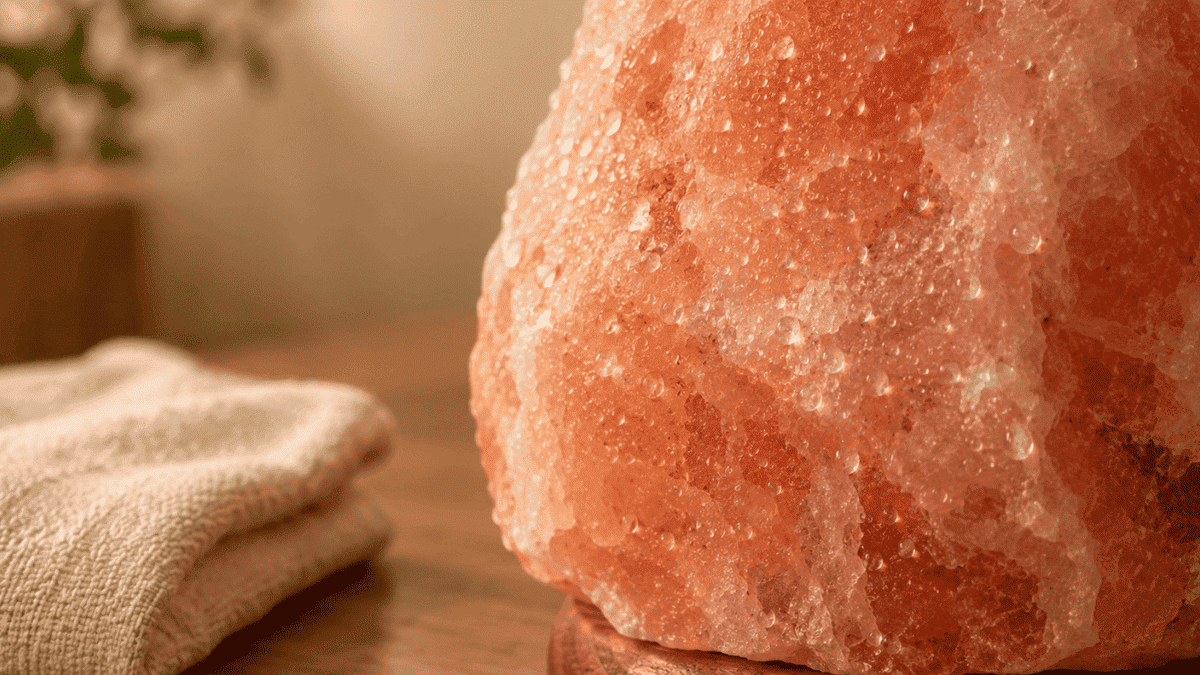
How to Tell a Real Himalayan Salt Lamp From a Fake
Fake “salt lamps” made from other minerals or dyed salt are common online. A few signs help:
- Uneven color and glow. Real Himalayan salt has bands and patches of pink, orange and white. A lamp with perfectly uniform, bright color is suspicious.
- Natural imperfections. Small cracks, veins and rough spots are normal.
- It reacts to humidity. Real salt will get slightly damp in humid air. A lamp that never shows any moisture, even in a humid room, may not be salt.
- A clear origin. The seller should be able to tell you where the salt comes from. Genuine Himalayan salt comes from the Salt Range in Pakistan.
- It is heavy for its size. Rock salt is dense.
None of these is a lab test, but together they are a good guide.
Choosing the Right Lamp
Pick a lamp for the space and the look you want, not for a health promise.
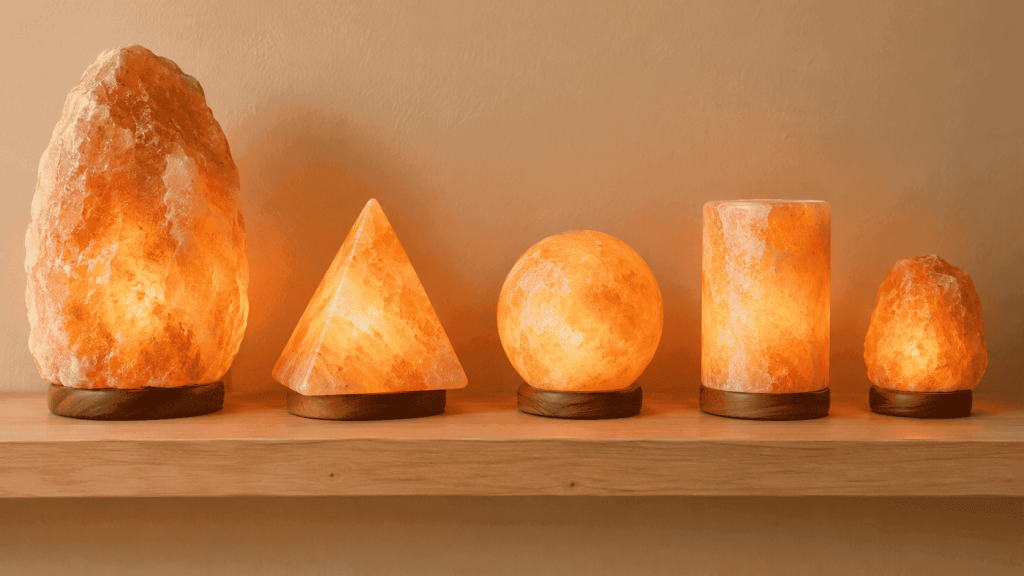
- Natural shape (around 9–12 kg): a rugged, organic piece for living rooms and lobbies.
- Pyramid (around 2–3 kg): clean lines for desks and shelves.
- Ball (around 3–4 kg): a softer, modern shape for bedrooms and reading corners.
- Cylinder cut (around 2.5–3.5 kg): a contemporary look for offices and studios.
- Rocky (around 2–3 kg): a smaller natural piece for side tables.
A bigger lamp gives more glow, but even a small one is enough for a bedside light. You can see all five shapes on our Himalayan salt lamps page.
For Retailers and Importers: Selling Salt Lamps Honestly
If you sell salt lamps, the honest angle is also the safer one. In the United States, health claims in advertising are expected to be backed by evidence, and “purifies the air” or “treats allergies” on a box is hard to defend. Customers are also more skeptical than they were a few years ago, as the search results for this very question show.
What sells well instead: the warm light, the natural origin, the handmade character and the gift appeal. Lamps with certified cords for the destination market, sturdy bases and careful packing also mean fewer returns.
At Mount Grain, we supply Himalayan salt lamps sourced from Pakistan’s Salt Range to importers, retailers and gift stores, in bulk and with private label packaging. If you are planning to stock salt lamps, request a wholesale quote and tell us which shapes and markets you need.
FAQs
Do salt lamps really work?
They work as a warm, dim light and a decor piece. There is no reliable evidence that they purify the air, release meaningful negative ions or improve health.
Should you sleep with a salt lamp on?
You can, if the cord and dimmer are in good condition and the light is kept low. Turn it off if light keeps you awake, and switch it off when you leave home.
How many hours a day should a salt lamp be on?
There’s no health-based number. In humid climates, running it for several hours a day while you’re home keeps the salt dry and stops it from sweating.
Where should you not put a salt lamp?
Avoid bathrooms, spots near sinks or humidifiers, outdoor areas, bare wood or metal surfaces, unsteady shelves, and anywhere pets or small children can reach.
Are salt lamps safe for cats and dogs?
Not really, especially for cats. Repeated licking can cause salt poisoning. Keep lamps out of pets’ reach or avoid them in homes with cats.
Why is my salt lamp wet?
Salt absorbs moisture from humid air. Switch the lamp on to dry it and wipe it with a dry cloth. Unplug and dry it first if it is dripping heavily.
Do salt lamps help with allergies?
No evidence supports this. Halotherapy, which involves breathing fine salt particles, is a different thing; a lamp releases no salt into the air.
How long does a salt lamp last?
The salt itself can last for many years if kept dry. Bulbs and cords need replacing over time.